

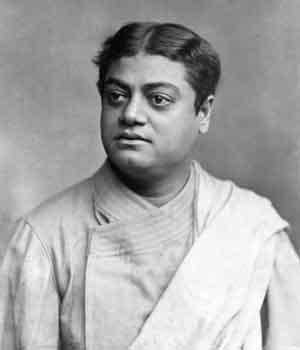
Vivekananda as the Turning Point

Was Vivekananda’s Appearance on the Scene of the World History a Turning Point?
THIRTY YEARS AFTER his birth, in 1893, Vivekananda had stormed the Western world with his groundbreaking ideas on religion and philosophy. With this had begun his epochal mission. He remarked in 1896 when he was in England: ‘I will have a lot of difficult work to do in this life. Compared with the last time, there is much more to be done. … This time I will work up to the very last moment! … I have just begun my work; in America I have raised only one or two waves; a tidal wave must be raised; society must be turned upside down; the world must be given a new civilisation.’1
In these words, we get some hints about Vivekananda’s real identity and the mission he came to fulfil. There is a prophetic ring about them. What astonishes us most is the fact that the person who was talking about turning the society upside down and giving the world a new civilisation was not a politician, a statesman, a military leader, or a business magnet with huge material and human resources behind. He was a penniless monk, that too, belonging to a battered, beleaguered, slave nation—a nation at that time labelled to be the abode of heathens!
It was the middle of the nineteenth century. The vicissitudes of the civilisation of the time made it necessary for the emergence of a new spiritual wave. In response, a new spiritual wave did rise, of which Sri Ramakrishna was the centre, and Swamiji, his herald. Any discussion on Swamiji will remain incomplete without referring to the source of his power, Sri Ramakrishna, who was embodying in himself the new spiritual wave. Swamiji was his voice, his instrument. This new tidal wave of spirituality which Swamiji voiced forth has been since then silently influencing the lives of people everywhere. Was Swamiji’s appearance on the scene of the world history then a turning point?
The Meaning of Turning Point
The term ‘turning point’ has been widely in use in different streams of human study and research. It has been especially used by historians, apart from political scientists, social scientists et al. Even in individual lives, we find this term commonly used. Successes like getting a job, getting married, an acquaintance with a distinguished personality, or even disappointments like a failure of a marriage, losing a job and becoming a destitute, or death of a kin, may turn the course of a person’s life—making the incident a turning point. The same thing may happen with regard to a group of persons, a society, a nation, a race, or the world. An event is said to be a turning point if it brings about a significant change, a paradigm shift, in a person’s life, or in the collective life of human beings, or in the course of human history.
The well-known turning-point events of history can be broadly classified under the following heads: political, military, scientific, and ideological. When a stable political system of a society is disrupted by events threatening the very existence of that system, it may result in fundamental changes in the existing political outlook and ways of governance. The American Revolution, the French revolution, the Bolshevik revolution, and the dismantling of Soviet Russia are the instances of this kind. Alexander’s expedition, the crossing of the Rubicon by Julius Caesar, the rise of the Mongols, the Islamic invasion of India, and the battle of Plassey are the instances of turning points brought about by military adventures. These were to alter the map of the world in new ways. Then there have been scientific and technological revolutions changing the face of civilisation altogether. Discovery of the wheel, the harnessing of the fire, Neolithic and industrial revolutions, discoveries of electricity, gunpowder, aeroplane, nuclear power, space flights, computer, and internet belong to this category.
The emergence of new worldviews (weltanschauung) constitutes the turning-point events of the ideological kind, which result in a lasting change in the way human beings conduct themselves. In a very general way, we may say that the major worldviews in human history have been the gift of great philosophers and religions born at different junctures. We have, for example, the most ancient view of God, life, morality, and existence found in the Vedas; then there is the Zoroastrian view, the Old-Testament view, the Buddhist, the Christian, and the Islamic view. Each of these ideologies/religions has changed the course of human lives and has been responsible in drastic demographic alterations from time to time.
The founders of these religions came on the scene when the degenerating materialistic ethos of life took hold of the minds of the people. To counter this spell of degeneration, each appeared standing on the crest of a mighty spiritual thought-wave to regenerate humankind. Krishna, Buddha, Christ, or Mohammad—the appearance of each one of these persons has been a turning point in the history of the world. They were responsible in bringing about dramatic changes in human understanding about God, creation, and life. Each came and provided a worldview according to the need of the time, raising the spiritual quality of human life and civilisation by several notches.
Ideological turning points in the form of the birth of great religions are more fundamental compared to the other kinds. The former steers the course of the collective lives of the people from the ‘inside’, whereas the latter impact only on the ‘outside’. The latter—the political and military milestone events—are often influenced by the former, the contemporary worldviews. But it is the physical events which usually grip our attention, whereas the various ideologies which steer the large sections of the human race from ‘within’ go unnoticed or unstressed. One of the reasons for this is that the turning-point events of the political, military, or the scientific kinds bring about abrupt changes in society which is easily discernible to the gross eyes. Take for instance the present Corona pandemic. It is clearly discernible that it has impacted the lives of the entire human race at present. But it takes a long period for the changes brought about by a new ideology or worldview to become noticeable.
In short, the turning point is about assigning importance to certain past events in history. An event will be a turning point in the true sense only if its impact lasts on the society over a long period of time resulting in dramatic changes in the collective lives of human beings.
Vivekananda as the Turning Point
Applying this yardstick to the event of Vivekananda’s advent, can we say that his appearance on the scene of the world history is a turning point? It is only a little more than one-hundred and fifty years since he was born. Admittedly, it may be argued that this span of time is too small to gauge the influence of his life on human society. At the same time, there are enough evidences of the striking kind to prove the influence of his life and ideas on the world. He opened the floodgates of spiritual universalism, which has been guiding the world in a new direction. As stated before, the climacteric events of the ideological kind bring about a change in the people’s life from the ‘inside’. For instance, historically speaking, whenever the lives of the people in India plunged into the darkness of materialism and degradation, there arose great teachers who spread the message of Vedanta. Their influence has been silent and of the lasting kind, impacting the Indian society for several centuries, and even spilling over into distant lands.
The ideological and overall scenario in nineteenth-century India and the world was pathetic to the extreme. India had sunk into the darkness of poverty—both material and ideological. She had, as if, lost her moorings. Gazing around in utter awe of the dazzling Western civilisation, she stood confused about her course of action. India was lost in the wilderness of degeneration, whereas the West was basking in the sun of striking material progress through science and technology. India had forgotten her spiritual roots, and West was strongly anchored in the materialistic ethos of life. Imperialistic enterprises, the subjugation of the foreign lands, exploitation, and strong religious dogmatism characterised the West. Racial fanaticism and bigotry were intense in the West.
In short, it was a period when the world had plunged in the darkness of wrong ideas and destructive worldviews. The forces making for differentiation and fragmentation of the human race were reigning supreme. The time was ripe for the stream of Universal Life to send forth a mighty spiritual wave of unification and integration. That wave appeared in the form of Ramakrishna and Vivekananda. As stated before, Ramakrishna was the centre of this unifying force, and Vivekananda was his herald.
Ramakrishna’s Predictions about Vivekananda
Right from his earliest meetings with Naren (later Swami Vivekananda), Ramakrishna had recognised him to be the person he was waiting for. Naren was then just in his early-20s. On different occasions, he had prophesied about what Naren was going to accomplish in future. When Naren visited Ramakrishna for the first time, the latter observed: ‘I know you are that ancient sage, Nara, the Incarnation of Narayana, born on earth to remove the miseries of mankind.’2
The Life of Swami Vivekananda narrates:
One day Sri Ramakrishna was seated in his room with Keshabchandra Sen, Vijaykrishna Goswami and other celebrated leaders of the Brahmo Samaj. Narendranath was also present. The Master, in an exalted mood, cast his eyes upon the Brahmos and then on Naren, and, as a picture of the latter’s future greatness flashed before his mind, he was filled with tenderness for the disciple. After the meeting was over he said to some devotees, ‘Well, if Keshab is possessed of one sign of greatness which has made him famous, Naren has eighteen such signs. In Keshab and Vijay I saw the light of knowledge burning like a candle-flame, but in Narendra it was like a blazing sun, dispelling the last vestige of ignorance and delusion’ (1.88).
In those days of Keshab’s immense celebrity, none could have spoken about Naren in this light without being labelled as insane! Ramakrishna could do that, because he was not guessing, but seeing.3
Further, in Cossipore garden-house, Ramakrishna declared: ‘Naren will teach others.’4 Sometime before this, he had told Naren: ‘My siddhis (powers) will manifest through you in time’ (ibid.). A few days before he passed away, Ramakrishna transmitted his powers to Naren and said: ‘O Naren, today I have given you my all and have become a fakir, a penniless beggar. By the force of the power transmitted by me, great things will be done by you; only after that will you go where you came from’ (ibid.). After Naren had the experience of nirvikalpa samādhi for the first time, Ramakrishna told the other disciples: ‘Naren will pass away only of his own will. The moment he realises who he is, he will refuse to stay a moment longer in the body. The time will come when he will shake the world to its foundations through the strength of his intellectual and spiritual powers. I have prayed that the Divine Mother may keep this realisation of the Absolute veiled from Naren. There is much work to be done by him’ (178–9). (Italics added for emphasis)
At the time when Ramakrishna passed these prescient remarks, many around him might have set these assertions aside, thinking these to be nothing more than the outpourings of his love for his dear disciple—and it was quite justifiable for them to do so. In those days there was nothing in the air to hint at the possibility of Naren having a momentous future of global dimension! But today, in retrospect, we wonder at Ramakrishna’s remarks about him, every word of which has turned out to be true. Today, Vivekananda’s life and achievements, and the worldwide impact of his universal ideas, are a matter of deep interest and lasting relevance to the human race, slowly gaining acceptance among the scholars as well as the laity. In the view of the renowned Indologist A L Basham, Vivekananda was the first Indian religious teacher to make an impression outside India in the last one thousand years.
Impact of Vivekananda’s Work
After the passing away of Sri Ramakrishna, how Naren became Swami Vivekananda and stormed the Parliament of Religions in 1893 is a well-known story to be reiterated here. In the words of his great Master, he was to ‘shake the world to its foundations’ (ibid.). The West discovered the glory of the East, and India woke up from her long slumber. To put it in Vivekananda’s own words, ‘… the world was to be given a new civilisation’, a spiritual civilisation. ‘This is the great ideal before us’, he asserted, ‘and everyone must be ready for it—the conquest of the whole world by India—nothing less than that, and we must all get ready for it, strain every nerve for it. Let foreigners come and flood the land with their armies, never mind. Up, India, and conquer the world with your spirituality!’5 In the short span of nine years he sowed the seeds of this gigantic mission. He placed before the world a new framework of universal ideas based on Vedanta, and through that, he laid the foundation of a gradual and silent transformation of the human race from ‘within’. The world was never to remain the same again. His ideological framework has been silently influencing human thought and actions everywhere. About the impact of his electrifying words and ideas on India and the West, the great French savant Romain Rolland wrote:
Imagine the thunderous reverberations of these words! …The storm passed; it scattered its cataracts of water and fire over the plain, and its formidable appeal to the Force of the Soul, to the God sleeping in man and His illimitable possibilities! I can see the Mage erect, his arm raised, like Jesus above the tomb of Lazarus in Rembrandt’s engraving:6 with energy flowing from his gesture of command to raise the dead and bring him back to life. …
Did the dead arise? Did India, thrilling to the sound of his words, reply to the hope of her herald? Was her noisy enthusiasm translated into deeds? … the Master’s rough scourge made her turn for the first time in her sleep, and for the first time, the heroic trumpet sounded, in the midst of her dream, the Forward March of India, conscious of her God. She never forgot it. From that day the awakening of the torpid Colossus began. If the generation that followed saw, three years after Vivekananda’s death, the revolt of Bengal, the prelude to the great movement of Tilak and Gandhi, if India today has definitely taken part in the collective action of organised masses, it is due to the initial shock, to the mighty ‘Lazarus, come forth’ of the message from Madras.
This message of energy had a double meaning: a national and a universal. Although, for the great monk of the Advaita, it was the universal meaning that predominated, it was the other that revived the sinews of India.7 (Italics added for emphasis)
It is easy for us to discuss and study the impact of Vivekananda’s life and ideas from a distance of more than a century and a half. But it demands an insight of no less than a prophet to precisely peep into the future and see how particular ideas assume concrete shapes. Swamiji clearly foresaw the way his ideas would transform the world in course of time. He had stated: ‘I have given them [to the world] enough for fifteen-hundred years.’8 He came to give a new civilisation to the world, as stated before. To set his ideas in motion, he established an organisation and remarked: ‘And now a vision comes to my mind! This Math shall become a great centre of learning and spiritual practices.’ Then, turning to his disciple, he asked: ‘What do you think of it?’ The disciple respectfully expressed the doubt that this ‘most excellent piece of fancy’ would ever materialise! ‘Fancy, do you say!’ Vivekananda cried out, ‘Hear me, O you of little faith! Time will fulfil all my expectations. I am now only laying the foundation.’9 A few days later he again told his disciple: ‘This Math will be the central institution for the practice of religion and the cultivation of knowledge. The spiritual force emanating from here will permeate the whole world, turning the currents of men’s activities and aspirations into new channels. … All these visions are rising before me’ (ibid.). (Italics added for emphasis)
It is interesting to note the spiritual mission of Vivekananda in the contrasting milieu of the contemporary political and military animosity between nations. The wave of spirituality that had risen had to slowly make a way in and through the milieu of religious and political hatred of the time. The period was reflecting the fiercest struggle between the forces of fragmentation and the forces of unification. And the spiritual wave set in motion by the stream of Universal Life was functioning to peter out the forces of disintegration and destruction. It was silently moving ahead to bring about a unification of the world. As early as in 1897, Vivekananda had foreseen the need of international organisations and remarked: ‘Even in politics and sociology, problems that were only national twenty years ago can no more be solved on national grounds only. They are assuming huge proportions, gigantic shapes. They can only be solved when looked at in the broader light of international grounds. International organisations, international combinations, international laws are the cry of the day.’10 Within a few decades after that, there came into existence ‘The League of Nations’, which later became ‘The United Nations’.
In and through all these struggles, the collective mind was slowly undergoing a change. About the impact of Vivekananda’s ideas on the West, Marie Louise Burke wrote: ‘As I see it, his gigantic mission in America (and also, of course, in England) was to alter at its deepest source the whole thought-current of the Western people.’11 Vivekananda had given a new turn to the global thought-current.
Finally, we have to note one important point. The turning-point events in the sphere of ideology are often seen to have their influence in silence, unlike the climacteric events in the military and political spheres, which are usually followed by violence and bloodshed. This is particularly true of India. The great turning-point ideologies emanating from India have been seen to influence the world imperceptibly, in silence. ‘Our message has gone out to the world many a time, but slowly, silently, unperceived’, Vivekananda remarked. ‘…The one characteristic of Indian thought is its silence, its calmness. At the same time, the tremendous power that is behind it is never expressed by violence. It is always the silent mesmerism of Indian thought. … Like the gentle dew that falls unseen and unheard, and yet brings into blossom the fairest of roses, has been the contribution of India to the thought of the world. Silent, unperceived, yet omnipresent in its effect, it has revolutionised the thought of the world, yet nobody knows when it did so.’12 (Italics added for emphasis)
This aforesaid observation of Vivekananda about the characteristic of Indian thought is precisely an observation about his own ideas and their influence. In the last one-hundred or more years, his thoughts have been silently revolutionising the thought currents of the world, yet nobody knows when it did, and who was behind it. It is the ideas that matter and not the person. ‘My name should not be made prominent; it is my ideas that I want to see realised. … Work for the ideas, not the person’, said Vivekananda.13
This has been the legacy of the greatest minds born in India from time immemorial.
March on
In 2021, when we look back at the course of the stream of collective human thought, we find its ingredients and colour changed to a great extent. A large section of the human society today is thinking and working to bring about the unification of the human race. This may not be discernible on the surface, but it is there. Undeniably, there is a long way ahead of us for the attainment of the ideal state of civilisation, and we need to march on. Our aim is to make a society where human beings would live in dignity and respect, where the evaluation of the human beings would not be based upon what one possesses but upon the simple fact that one is a human being, the conscious reflector of the Divine, where the society would be freed from the scourge of poverty, malnourishment, gender discrimination, racial and religious hatred, hedonism, the exploitation of the women and the weaker sections of the society, and where the spiritually integral view of life would reign supreme, based upon the universal religion of Divine Love. The 125th year of Prabuddha Bharata is an important milestone in this journey initiated by Swami Vivekananda.
Notes and References
1. Marie Louise Burke, Swami Vivekananda in the West—New Discoveries, 6 vols (Kolkata: Advaita Ashrama, 1985), 4.142. Hereafter New Discoveries.
2. His Eastern and Western Disciples, The Life of Swami Vivekananda, 2 vols (Kolkata: Advaita Ashrama, 2004), 1.76. Hereafter Life.
3. During the 1880s Keshabchandra Sen was a renowned person. He had attained great renown even in England through his powerful oratory. Naren was then only a student.
4. Life, 1.182.
5. The Complete Works of Swami Vivekananda, 9 vols (Calcutta: Advaita Ashrama, 1–8, 1989; 9, 1997), 3.276–7.
6. An allusion to a famous engraving of Rembrandt: The Resurrection of Lazarus.
7. Romain Rolland, The Life of Vivekananda and the Universal Gospel (Kolkata: Advaita Ashrama, 1975), 113–4.
8. Swami Vivekananda on Himself (Kolkata: Advaita Ashrama, 2007), 339.
9. Life, 2.400.
10. Complete Works, 3.241.
11. Marie Louise Burke, Swami Vivekananda, Prophet of the Modern Age (Kolkata: Gol Park, The Ramakrishna Mission Institute of Culture, 1974), 14–15.
12. Complete Works, 3.274.
13. Complete Works, 5.68.
Source: Prabuddha Bharata, January 2021 (Vol. 126, No. 1), pp. 54–60. Read the original issue.
About the author
Swami ShuddhidanandaSwami Shuddhidananda is the Adhyaksha of Advaita Ashrama, Mayavati, with a publication centre in Kolkata.
All articlesComments
Sign in to leave a comment