

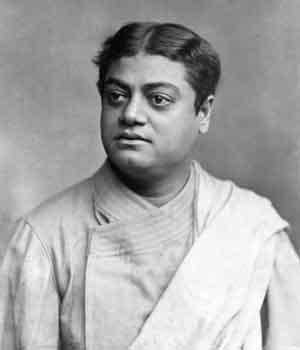
On the Poem ‘To the Awakened India’

To the Awakened India
Swami Vivekananda
Once more awake!
For sleep it was, not death, to bring thee life
Anew, and rest to lotus-eyes, for visions
Daring yet. The world in need awaits, O Truth!
No death for thee!Resume thy march,
With gentle feet that would not break the
Peaceful rest, even of the road-side dust
That lies so low. Yet strong and steady,
Blissful, bold and free. Awakener, ever
Forward! Speak thy stirring words.Thy home is gone,
Where loving hearts had brought thee up, and
Watched with joy thy growth. But Fate is strong
This is the law,—all things come back to the source
Their strength to renew.Then start afresh
From the land of thy birth, where vast cloud-belted
Snows do bless and put their strength in thee,
For working wonders anew. The heavenly
River tunes thy voice to her own immortal song;
Deodar shades give thee eternal peace.And all above,
Himala’s daughter Umâ, gentle, pure,
The Mother that resides in all as Power
And Life, Who works all works, and
Makes of One the world. Whose mercy
Opes the gate to Truth, and shows
The One in All, give thee untiring
Strength, which leads to Infinite Love.They bless thee all,
The seers great whom age nor clime
Can claim their own, the fathers of the
Race, who felt the heart of Truth the same,
And bravely taught to man ill-voiced or
Well. Their servant, thou hast got
The secret,—’tis but One.Then speak, O Love!—
Before thy gentle voice serene, behold how
Visions melt, and fold after fold of dreams
Departs to void, till Truth and Truth alone,
In all its glory shines.—And tell the world—
Awake, arise, and dream no more!
This is the land of dreams, where Karma
Weaves unthreaded garlands with our thoughts,
Of flowers sweet or noxious,—and none
Has root or stem, being born in naught, which
The softest breath of Truth drives back to
Primal nothingness. Be bold, and face
The Truth! Be one with it! Let visions cease,
Or, if you cannot, dream but truer dreams,
Which are Eternal Love and Service Free.
This poem first appeared in the August 1898 issue of Prabuddha Bharata, the first issue published from Almora.
A Note on ‘To the Awakened India’
Asim Chaudhuri
THE ABOVE POEM is Swami Vivekananda’s contribution to the magazine Prabuddha Bharata in August 1898, when the magazine was transferred from Madras to Almora, and Swami Swarupananda became the editor.
When and how Swamiji got the inspiration to write such a poem is debatable. It was probably submitted in June or early July 1898, when he was travelling in northern India. The magnificent sight of the Himalayas could have stimulated him to put down in black and white the thoughts he had since he came back from his first tour of the West. What mission he started single-handedly, he wanted his countrymen to join in.
In the poem, Swamiji is telling the people of India to awake again and tell the world the Truth, which the world direly needs. He has full faith in the country; it is not dead, only in deep slumber, needing rejuvenation. He wants India to resume the march it had once started, her stirring words gently and quietly engulfing the world. Also Swamiji refers to the occupied country, but tells his countrymen never to forget their heritage and start afresh with renewed vigour, even if they have lost their homes temporarily. They could draw their strength from the snow-clad Himalayas, their resonant voice, which awakens people to their own power from the murmuring Ganges, and their peace from the cool shade of the Deodar trees. Swamiji is also asking his fellow countrymen to bow to the Mother, the source of his own strength, and who is behind everything that happens in the world. She shows us the truth, the Oneness, and gives us the strength and capacity to love.
Swamiji, in the poem, pays homage to our great seers by calling them ‘the fathers of the race’, and lauds them for telling everyone the Truth: ‘It is but One’, or ‘Ekam sat viprā bahudhā vadanti—that which exists is One; sages call It by various names’. He urges his countrymen not to tell the world to sleep and dream, but to tell it what the seers taught them about Oneness, which contravenes what good or bad Karma would bring to us. The Truth alone can teach us to love all people, all the time, and serve them unselfishly.
An author and a well-known researcher on Swami Vivekananda, Asim Chaudhuri is associated with the Vedanta Society of Southern California.
A Literary Approach to Swami Vivekananda’s ‘To The Awakened India’
Dr R Ramachandra
CAN ONE APPROACH this poem of Swami Vivekananda without paying attention to its unusual punctuation—a feature that perplexes even the most meticulous editors of anthologies and collections?1 At the outset, let us set the original text as printed in the August 1898 issue of Prabuddha Bharata (PB) alongside the version that appears in The Complete Works of Swami Vivekananda (CW) and note down a few of the numerous deviations in this regard. The comparison is made not by way of disparagement, but to register the reader’s bewilderment on sighting the apparently ‘eccentric’ punctuation by the monk who declared that he was ‘first and foremost a poet’.2
Stanza 7
Text, according to PB:
‘Then speak, O Love! —’ (Note the dash, in addition, the sign of exclamation)
CW version:
‘Then speak, O Love!’ (The dash is removed)
Stanza 8
PB: ‘Of flowers sweet or noxious, — and none’ (A dash follows the comma)
CW: ‘Of flowers sweet or noxious, and none’ (The dash is dropped).
Without making an exhaustive list of such deviations, it may be a good literary exercise to juxtapose the two variant versions of stanza five. First, from PB:
And all above,
Himala’s daughter Umâ, gentle, pure,
The Mother that resides in all as Power
And Life, Who works all works, and
Makes of One the world. Whose mercy
Opes the gate to Truth, and shows
The One in All, give thee untiring
Strength, which leads to Infinite Love.
Now, the same lines from CW:
And all above,
Himala’s daughter Umâ, gentle, pure,
The Mother that resides in all as Power
And Life, who works all works, and
Makes of One the world, whose mercy
Opens the gate to Truth and shows
The One in All, give thee untiring
Strength, which is to Infinite Love.
In quotation 1, letter ‘w’ is capitalised twice before the end of the sentence (Once after a comma, and again, after a period). Quotation from Complete Works changes these, prompted by grammatical sense, probably; prefers the word ‘open’ for its archaic form ‘ope’. Also, changes in the wordings in the last lines are effected. Let us proceed to read the poem with the uneasy feeling that grammatical sense and poetical sense could be in mutual conflict.
Two quotations may help us to orient ourselves to Swamiji’s poetry in general and ‘To the Awakened India’ in particular. The first quotation is from Prof. C D Narasimhaiah, a well-known writer and literary critic:
(Vivekananda) is more in the tradition of poet-teachers of the Vedas and Upanishads, the later Veerashaiva Vachanakaras and the Haridasas of Karnataka, of the mystic poets of Maharashtra and Bengal, and, unlike any of these, made alive by the spirit of European science.3
Narasimhaiah’s observation implies that Swamiji’s poem is to be read more with the ear than with the eye. The other quotation is from the great novelist, Joseph Conrad’s A Personal Record: ‘The power of the sound has always been greater than the power of sense.’4
Now to listen a little to the poem: There is a tendency to describe the poem as a ‘clarion call’ to the youth of India. Clarion, essentially associated with war, sounds too loud in the context of the poem. The sharpness in ‘Arise! Awake! and stop not until the goal is reached’5 is greatly diminished by the two single syllabled words ‘once more’ with which the poem opens: ‘Once more awake!’
Swamiji knew that nations and civilisations, like individuals, slip away to sleep and even to death. But it is awakening time for India now. She has woken up many times from a sleep-state earlier, and the poet exhorts the nation to wake up yet another time in response to the expectations of the world ‘in need’. India is variously referred to as ‘Truth’, ‘Awakener’ and ‘Love’ in this poem:
‘The world in need waits, O Truth!’
‘Awakener, / ever
Forward!’‘Then speak, O Love!—’
India is regarded as Divinity that guides the world. Its sleep-state was actually ‘rest to lotus-eyes’. It is common knowledge that in the Indian consciousness lotus stands for ‘vision’ and spiritual awakening. In Indian literature, the term ‘lotus-eyes’ is employed to convey the idea of all-encompassing vision: ‘Pundareekāksha’, ‘Rajeeva Lochana’, ‘Kamala Nayana’ (all names have one meaning, that is, one who has lotus eyes). Incidentally, lotus also symbolises rebirth or renewal.
A surprising element lies in the expression ‘Daring yet’. There were visions earlier; but greater, more astonishing visions are to unfold this time. There appears to be an oblique reference to the chakras/nerve-centres along the Sushumna in yogic literature where the nerve-centres are likened to lotuses of a varying number of petals. (One cannot forget that Swamiji was a yogi whose authoritative discourses on Raja Yoga continue to have powerful, and widespread appeal.) The ascent of Kundalini through the chakras marks the progress to higher levels of consciousness, and hence, ‘visions daring yet’. The call is for the awakening of national consciousness. One sees in this poem a bold identification of individual consciousness with national consciousness. The call then is for the awakening of national consciousness.
This awakening is to be effected inconspicuously, for all spiritual progress takes place invisibly, inwardly although steadily. So,
Resume thy march,
With gentle feet that would not break the
Peaceful rest, even of the road-side dust,
That lies so low.
It is the inwardness of the poem that accounts for the soft syllables and sibilant sounds that pervades the poem:
‘and rest to lotus-eyes for visions’
‘Peaceful rest, even of the road-side dust
That lies so low. Yet strong and steady,
Blissful, bold and free.’‘Who works all works, and
Makes of one the world. Whose mercy
Opes the gate to Truth, and shows
The One in All give thee untiring
Strength, which leads to Infinite Love’‘The seers great whom age nor clime
Can claim their own, the fathers of the
Race, who felt the heart of Truth the same’‘Weaves unthreaded garlands with our thoughts,
Of flowers sweet or noxious—and none’And so on…
One of the effects of the repeated ‘s’ sound in combination with soft syllables is that it creates a sense of sanctity. More than a clarion call associated with the war cry, the poem reminds one of the hymns that are sung in temples to wake up the deity. Purandara Dasa, a famous saint of Karnataka, in one such hymn says:
Wake up Hanumantha, how long would you sleep? There’s much for you to do; you have to carry news of Rama’s well-being to Sita; cross the ocean; bring the signet ring to Rama; vanquish the evil forces and bring back Janaki to Ayodhya; and so, how long would you sleep?
It’s almost a re-enactment of Ramayana. It is a similar exhortation that we hear in ‘To the Awakened India’. Also, we note that a whole past is assimilated in order to look forward to a glorious future:
The seers great whom age nor clime
Can claim their own, the fathers of the
Race, who felt the heart of Truth the same,
And bravely taught to man ill-voiced or
Well.
The allusion to ‘the fathers of the / Race’ points to mythical ‘Sapta Rishis’, the immortal wise Teachers from whom the descent of the human race begins. The poem does not relate ancestry or lineage to kings of military might but to a line of wise teachers; the descent of tradition is from teacher to teacher who will lead to Truth, which is synonymous with ‘Infinite’, ‘Eternal Love’ and ‘Service’.
Another effect of sibilance lies in slowing down the pace of reading so that the poem acquires a meditative quality. This meditative quality is further accentuated by the apparently ‘wild’ use of caesura (a pause near the middle of a line) and enjambments6 which make the reader progress very slowly, almost haltingly, through the poem. Caesura and enjambments are used as creative devices here. Literature students know that caesura is an extra pause in a line, normally indicated by a punctuation mark or by a capital letter. ‘To the Awakened India’ employs very strong caesuras (a dash coupled with a comma, or an exclamation mark or a period) which is very rarely seen in poetry. The significance of Emily Dickinson was not recognised for a long time because of her use of caesura, especially through dashes that defied conventions of grammar. But then, who dares dictate language rules to a poet? The poet in Swamiji rejects rules of grammar and structures of poetry. What he valued most in poetry was its suggestive power, which is why he discouraged too much description in poetry.
One sees throughout the poem the use of enjambment. Enjambment refers to a poetic line that runs on to the next line without completing a sentence. Together, caesura and enjambment regulate the pace of reading and enact the alternating pauses and flights of consciousness.
Poetic thought or poetic feeling determines the structure of a poem and not the mechanical rules of metre, rhyme, and grammar. Like all great religious poets, Swamiji was acutely aware of the inability of language in rendering Infinity (cf. the Upanishadic line ‘There the eye goes not, nor words, nor mind’).7 Hence the use of paradox as a poetic strategy. How else do we approach the last stanza?
And tell the world—
Awake, arise, dream no more!
This is the land of dreams, where Karma
Weaves unearthed garlands with our thoughts,
Of flowers sweet or noxious,—and none
Has root or stem, being born in naught, which
The softest breath of Truth drives back to
Primal nothingness. Be bold, and face
The Truth! Be one with it! Let visions cease,
Or, if you cannot, dream then truer dreams,
Which are Eternal Love and Service Free.
The very progress of the poem, from the first stanza to the last one, enacts the unfolding of national and individual consciousness through dense paradoxes.
A former professor in the Department of English, University of Mysore, Dr R Ramachandra has authored six books both in English and Kannada.
Notes and References
1. ‘To the Awakened India’, The Complete Works of Swami Vivekananda, 9 vols (Calcutta: Advaita Ashrama, 1–8, 1989; 9, 1997), 4.387–9, and In search of God and Other Poems (2003), show punctuation schemes that are different from the one that appears in Prabuddha Bharata, August 1898.
2. Emily Dickinson, the American poetess who shunned public attention also followed a bizarre scheme of punctuation. Almost all her poems were discovered and published posthumously. She received critical acclaim as the greatest of American poets only decades after her death in 1890.
3. Narasimhaiah C D, The Swan and the Eagle: Essays on Indian English Literature (Indian Institute of Advanced Study, Shimla: Motilal Banarsidas, 1987), 43.
4. Conrad Joseph, A Personal Record: Some Reminiscences (New York: Cosimo Classics, 2005), xiii.
5. Complete Works, 1.342.
6. In poetry, enjambment is incomplete syntax at the end of a line; the meaning runs over from one poetic line to the next, without terminal punctuation. Lines without enjambment are end-stopped. <https://en.wikipedia.org/wiki/Enjambment#:~:text=In%20poetry%2C%20enjambment%20(%2F%C9%9B,without%20enjambment%20are%20end%2Dstopped.>
7. Kena Upanishad, 1.3.
Source: Prabuddha Bharata, January 2021 (Vol. 126, No. 1), pp. 67–72. Read the original issue.
Comments
Sign in to leave a comment