
Swami Vivekananda Quotes on Personality

Chapter 28: Personality
A profound collection of 30 sayings and teachings of Swami Vivekananda on Personality, compiled from the Complete Works of Swami Vivekananda (C.W.).
“Coming to great leaders of mankind, we always find that it was the personality of the man that counted. Now, take all the great authors of the past, the great thinkers. Really speaking, how many thoughts have they thought? Take all the writings that have been left to us by the past leaders of mankind; take each one of their books and appraise them. The real thoughts, new and genuine, that have been thought in this world up to this time, amount to only a handful. Read in their books the thoughts they have left to us. The authors do not appear to be giants to us, and yet we know that they were great giants in their days. What made them so? Not simply the thoughts they thought, neither the books they wrote, nor the speeches they made, it was something else that is now gone, that is their personality.”
“In the life of the householder, in the life of the poor, the rich, the man of business, the spiritual man, in every one’s life, it is a great thing, the strengthening of this personality.”
“In failure, one does not like to confess one’s own faults and weaknesses. Each person tries to hold himself faultless and lay the blame upon somebody or something else, or even on bad luck. When heads of families fail, they should ask themselves, why it is that some persons manage a family so well and others do not. Then you will find that the difference is owing to the man—his presence, his personality.”
“The personality of the man is two-thirds, and his intellect, his words, are but one-third. It is the real man, the personality of the man, that runs through us. Our actions are but effects. Actions must come when the man is there; the effect is bound to follow the cause.”
“The ideal of all education, all training, should be this man-making. But, instead of that, we are always trying to polish up the outside. What use in polishing up the outside when there is no inside? The end and aim of all training is to make the man grow. The man who influences, who throws his magic, as it were, upon his fellow-beings, is a dynamo of power, and when that man is ready, he can do anything and everything he likes; that personality put upon anything will make it work.”
“It is the man of strong will that throws, as it were, a halo round him and brings all other people to the same state of vibration as he has in his own mind. Such gigantic men do appear. And what is the idea? When a powerful individual appears, his personality infuses his thoughts into us, and many of us come to have the same thoughts, and thus we become powerful.”
“In every sphere of life we find that it is the person within that triumphs, and that personality is the secret of all success.”
“The science of Yoga claims that it has discovered the laws which develop this personality, and by proper attention to those laws and methods, each one can grow and strengthen his personality. This is one of the great practical things, and this is the secret of all education. This has a universal application.”
“Build up your character, and manifest your real nature, the Effulgent, the Resplendent, the Ever-Pure, and call It up in everyone that you see.”
“It is the force of character, of purity, and of truth—of personality. So long as I have these things, you can feel easy; no one will be able to injure a hair of my head. If they try, they will fail, saith the Lord. … Enough of books and theories. It is the life that is the highest and the only way to stir the hearts of people; it carries the personal magnetism.”
“Compare the great teachers of religion with the great philosophers. The philosophers scarcely influenced anybody’s inner man, and yet they wrote most marvellous books. The religious teachers, on the other hand, moved countries in their lifetime. The difference was made by personality. In the philosopher it is a faint personality that influences; in the great prophets it is tremendous. In the former we touch the intellect, in the latter we touch life. In the one case, it is simply a chemical process, putting certain chemical ingredients together which may gradually combine and under proper circumstances bring out a flash of light or may fail. In the other, it is like a torch that goes round quickly, lighting others.”
“Nothing makes us work so well at our best and highest as when all the responsibility is thrown upon ourselves. I challenge everyone of you. How will you behave if I put a little baby in your hands? Your whole life will be changed for the moment; whatever you may be, you must become selfless for the time being. You will give up all your criminal ideas as soon as responsibility is thrown upon you—your whole character will change. So if the whole responsibility is thrown upon our own shoulders, we shall be at our highest and best; when we have nobody to grope towards, no devil to lay our blame upon, no Personal God to carry our burdens, when we are alone responsible, then we shall rise to our highest and best.”
“Remember it is the person, the life, which is the secret of power— nothing else.”
“That character is of the noblest type in which all these three — knowledge and love and Yoga — are harmoniously fused. Three things are necessary for a bird to fly — the two wings and the tail as a rudder for steering. Jnana (Knowledge) is the one wing, Bhakti (Love) is the other, and Yoga is the tail that keeps up the balance.”
“As the tortoise tucks its feet and head inside the shell, and you may kill it and break it in pieces, and yet it will not come out, even so the character of that man who has control over his motives and organs is unchangeably established. He controls his own inner forces, and nothing can draw them out against his will. By this continuous reflex of good thoughts, good impressions moving over the surface of the mind, the tendency for doing good becomes strong, and as the result we feel able to control the Indriyas (the sense-organs, the nerve-centres). Thus alone will character be established, then alone a man gets to truth. Such a man is safe for ever; he cannot do any evil. You may place him in any company, there will be no danger for him.”
“Every human personality may be compared to a glass globe. There is the same pure white light—an emission of the divine Being—in the centre of each, but the glass being of different colours and thickness, the rays assume diverse aspects in the transmission. The equality and beauty of each central flame is the same, and the apparent inequality is only in the imperfection of the temporal instrument of its expression. As we rise higher and higher in the scale of being, the medium becomes more and more translucent.”
““It is the coward and the fool who says, 'This is fate'”—so says the Sanskrit proverb. But it is the strong man who stands up and says, “I will make my fate.” It is people who are getting old who talk of fate. Young men generally do not come to astrology. We may be under planetary influence, but it should not matter much to us. Buddha says, “Those that get a living by calculation of the stars by such art and other lying tricks are to be avoided”; and he ought to know, because he was the greatest Hindu ever born. Let stars come, what harm is there? If a star disturbs my life, it would not be worth a cent. You will find that astrology and all these mystical things are generally signs of a weak mind; therefore as soon as they are becoming prominent in our minds, we should see a physician, take good food and rest.”
“I was once travelling in the Himalayas, and the long road stretched before us. We poor monks cannot get any one to carry us, so we had to make all the way on foot. There was an old man with us. The way goes up and down for hundreds of miles, and when that old monk saw what was before him, he said, “Oh sir, how to cross it; I cannot walk any more; my chest will break”. I said to him, “Look down at your feet”. He did so, and I said, “The road that is under your feet is the road that you have passed over and is the same road that you see before you; it will soon be under your feet”. The highest things are under your feet, because you are Divine Stars; all these things are under your feet. You can swallow the stars by the handful if you want; such is your real nature. Be strong, get beyond all superstitions, and be free.”
“You must stand on your own feet. You must have this new method—the method of man-making. The true man is he who is strong as strength itself and yet possesses a woman’s heart.”
“It is the one test, that truth must make you strong and put you above superstition. The duty of the philosopher is to raise you above superstition. Even this world, this body and mind are superstitions; what infinite souls you are! And to be tricked by twinkling stars! It is a shameful condition. You are divinities; the twinkling stars owe their existence to you.”
“Remember this individualism at any cost! Think wrong if you will, no matter whether you get truth or not. The whole point is to discipline the mind. That truth which you swallow from others will not be yours. You cannot teach truth from my mouth; neither can you learn truth from my mouth. None can teach another. You have to realise truth and work it out for yourself according to your own nature. … All must struggle to be individuals—strong, standing on your own feet, thinking your own thoughts, realising your own Self. No use swallowing doctrines others pass on— standing up together like soldiers in jail, sitting down together, all eating the same food, all nodding their heads at the same time. Variation is the sign of life. Sameness is the sign of death.”
“How do I know that you are individuals—all saying the same thing, all standing up and sitting down together? That is the road to death! Do something for your souls! Do wrong if you please, but do something! You will understand me by and by, if you do not just now. Old age has come upon the soul, as it were. It has become rusty. The rust must be rubbed off, and then we go on.”
“All knowledge is in me, all power, all purity, and all freedom. Why cannot I express this knowledge? Because I do not believe in it. Let me believe in it, and it must and will come out.”
“What is now wanted is a combination of the greatest heart with the highest intellectuality, of infinite love with infinite knowledge.”
“With regard to Karma-Yoga, the Gita says that it is doing work with cleverness and as a science; by knowing how to work, one can obtain the greatest results. You must remember that all work is simply to bring out the power of the mind which is already there, to wake up the soul. The power is inside every man, so is knowing; the different works are like blows to bring them out, to cause these giants to wake up.”
“When you think upon a problem, there is no sense-enjoyment there, but the exquisite delight of thought. … It is that that makes the man. … Take one great idea! It deepens. Concentration comes. You no longer feel your body. Your senses have stopped. You are above all physical senses. All that was manifesting itself through the senses is concentrated upon that one idea. That moment you are higher than the animal. You get the revelation none can take from you—a direct perception of something higher than the body. … Therein is the gold of mind, not upon the plane of the senses.”
“Competitions for life or sex-gratification are only momentary, unnecessary, extraneous effects, caused by ignorance. Even when all competition has ceased, this perfect nature behind will make us go forward until everyone has become perfect. Therefore there is no reason to believe that competition is necessary to progress. In the animal the man was suppressed, but as soon as the door was opened, out rushed man. So in man there is the potential god, kept in by the locks and bars of ignorance. When knowledge breaks these bars, the god becomes manifest.”
“The whole of religion is our own inner perception. When I use the words “man-making religion,” I do not mean books, nor dogmas, nor theories. I mean the man who has realised, has fully perceived, something of that infinite presence in his own heart.”
“Every man must develop according to his own nature. As every science has its methods, so has every religion. The methods of attaining the end of religion are called Yoga by us, and the different forms of Yoga that we teach, are adapted to the different natures and temperaments of men. We classify them in the following way, under four heads: 1) Karma-Yoga—The manner in which a man realises his own divinity through works and duty. 2) Bhakti-Yoga—The realisation of the divinity through devotion to, and love of, a Personal God. 3) Rāja-Yoga—The realisation of the divinity through the control of mind. 4) Jnāna-Yoga—The realisation of a man’s own divinity through knowledge.”
“The power is with the silent ones, who only live and love and then withdraw their personality. They never say “me” and “mine”; they are only blessed in being instruments. Such men are the makers of Christs and Buddhas, ever living fully identified with God, ideal existences, asking nothing, and not consciously doing anything. They are the real movers, the Jivanmuktas, absolutely selfless, the little personality entirely blown away, ambition non-existent. They are all principle, no personality.”
Comments
Comments are closed for this post.
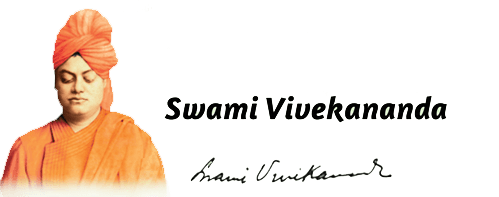
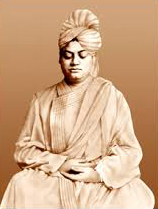
Swami Vivekananda (12 January 1863 – 4 July 1902) was an Indian saint, social reformer, and a great teacher of mankind. He was the foremost disciple of Bhagavan Sri Ramakrishna Paramahamsa Dev who is considered as the prophet of modern age. Swami Vivekananda was a towering spiritual personality, great thinker, orator and the prophet of universal harmony and progress.