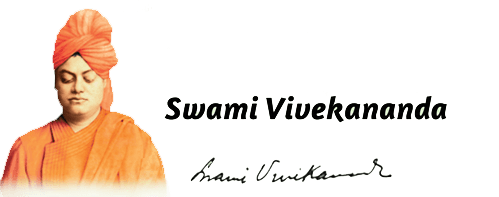

Swami Vivekananda Quotes on Hinduism

Chapter 17: Hinduism
A profound collection of 30 sayings and teachings of Swami Vivekananda on Hinduism, compiled from the Complete Works of Swami Vivekananda (C.W.).
“The Hindus found their creed upon the ancient Vedas, a word derived from Vid, “to know.” These are a series of books which, to our minds, contain the essence of all religion; but we do not think they alone contain the truths. They teach us the immortality of the soul.”
“The religion of the Hindus is divided into two parts: the ceremonial and the spiritual. The spiritual portion is specially studied by the monks.”
“The three essentials of Hinduism are belief in God, in the Vedas as revelation, in the doctrine of Karma and transmigration.”
“The Vedas teach that the soul is divine, only held in the bondage of matter; perfection will be reached when this bond will burst, and the word they use for it is therefore, Mukti — freedom, freedom from the bonds of imperfection, freedom from death and misery. And this bondage can only fall off through the mercy of God, and this mercy comes on the pure. So purity is the condition of His mercy. How does that mercy act? He reveals Himself to the pure heart; the pure and the stainless see God, yea, even in this life; then and then only all the crookedness of the heart is made straight. Then all doubt ceases. He is no more the freak of a terrible law of causation. This is the very centre, the very vital conception of Hinduism.”
“God is everywhere preached in the Gitā . Hinduism is nothing without God. The Vedas are nothing without Him. That is the only way to salvation. Sanyāsins have to repeat the following, several times: "I, wishing for Mukti, take refuge in God, who created the world, who breathed out the Vedas."”
“The Hindu believes that he is a spirit. Him the sword cannot pierce—him the fire cannot burn—him the water cannot melt—him the air cannot dry.”
“The Hindu does not want to live upon words and theories. If there are existences beyond the ordinary sensuous existence, he wants to come face to face with them. If there is a soul in him which is not matter, if there is an all-merciful universal Soul, he will go to Him direct. He must see Him, and that alone can destroy all doubts. So the best proof a Hindu sage gives about the soul, about God, is: “I have seen the soul; I have seen God.” And that is the only condition of perfection. The Hindu religion does not consist in struggles and attempts to believe a certain doctrine or dogma, but in realising—not in believing, but in being and becoming.”
“The Hindus have associated the idea of holiness, purity, truth, omnipresence, and such other ideas with different images and forms. But with this difference that while some people devote their whole lives to their idol of a church and never rise higher, because with them religion means an intellectual assent to certain doctrines and doing good to their fellows, the whole religion of the Hindu is centred in realisation. Man is to become divine by realising the divine. Idols or temples or churches or books are only the supports, the helps, of his spiritual childhood: but on and on he must progress.”
“The whole object of their (Hindu) system is by constant struggle to become perfect, to become divine, to reach God and see God, and this reaching God, seeing God, becoming perfect even as the Father in Heaven is perfect, constitutes the religion of the Hindus.”
“From the high spiritual flights of the Vedanta philosophy, of which the latest discoveries of science seem like echoes, to the low ideas of idolatry with its multifarious mythology, the agnosticism of the Buddhists, and the atheism of the Jains, each and all have a place in the Hindu’s religion.”
“The Hindus think very much of that knowledge or consciousness of the nearness of death, because it is taught in the Gita that the thoughts at the moment of departure are great powers in determining the next life.”
“The Hindu believes that every soul is a circle whose circumference is nowhere, but whose centre is located in the body, and that death means the change of this centre from body to body. Nor is the soul bound by the conditions of matter. In its very essence it is free, unbounded, holy, pure, and perfect. But somehow or other it finds itself tied down to matter, and thinks of itself as matter.”
“Unity in variety is the plan of nature, and the Hindu has recognised it. Every other religion lays down certain fixed dogmas, and tries to force society to adopt them. It places before society only one coat which must fit Jack and John and Henry, all alike. If it does not fit John or Henry, he must go without a coat to cover his body. The Hindus have discovered that the absolute can only be realised, or thought of, or stated, through the relative, and the images, crosses, and crescents are simply so many symbols — so many pegs to hang the spiritual ideas on. It is not that this help is necessary for every one, but those that do not need it have no right to say that it is wrong. Nor is it compulsory in Hinduism.”
“The Hindu refuses to call you sinners. Ye are the Children of God, the sharers of immortal bliss, holy and perfect beings. Ye divinities on earth — sinners! It is a sin to call a man so; it is a standing libel on human nature. Come up, O lions, and shake off the delusion that you are sheep; you are souls immortal, spirits free, blest and eternal; ye are not matter, ye are not bodies; matter is your servant, not you the servant of matter.”
“By the law of association, the material image calls up the mental idea and vice versa. This is why the Hindu uses an external symbol when he worships. He will tell you, it helps to keep his mind fixed on the Being to whom he prays. He knows as well as you do that the image is not God, is not omnipresent.”
“If a man can realise his divine nature with the help of an image, would it be right to call that a sin? Nor even when he has passed that stage, should he call it an error. To the Hindu, man is not travelling from error to truth, but from truth to truth, from lower to higher truth. To him all the religions, from the lowest fetishism to the highest absolutism, mean so many attempts of the human soul to grasp and realise the Infinite, each determined by the conditions of its birth and association, and each of these marks a stage of progress; and every soul is a young eagle soaring higher and higher, gathering more and more strength, till it reaches the Glorious Sun.”
“Every religion is only evolving a God out of the material man, and the same God is the inspirer of all of them. Why, then, are there so many contradictions? They are only apparent, says the Hindu. The contradictions come from the same truth adapting itself to the varying circumstances of different natures.”
“One fundamental doctrine of Hinduism is that all men are different, there being unity in variety. Even for a drunkard, there are some Mantras—even for a man going to a prostitute!”
“Hinduism indicates one duty, only one, for the human soul. It is to seek to realise the permanent amidst the evanescent. No one presumes to point out any one way in which this may be done. Marriage or non-marriage, good or evil, learning or ignorance, any of these is justified, if it leads to the goal.”
“The idea of an Objective God is not untrue — in fact, every idea of God, and hence every religion, is true, as each is but a different stage in the journey, the aim of which is the perfect conception of the Vedas. Hence, too, we not only tolerate, but we Hindus accept every religion, praying in the mosque of the Mohammedans, worshipping before the fire of the Zoroastrians, and kneeling before the cross of the Christians, knowing that all the religions, from the lowest fetishism to the highest absolutism, mean so many attempts of the human soul to grasp and realise the infinite, each determined by the conditions of its birth and association, and each of them marking a stage of progress. We gather all theseflowers and bind them with the twine of love, making a wonderful bouquet of worship.”
“Chemistry ceases to improve when one element is found from which all others are deducible. Physics ceases to progress when one force is found of which all others are manifestations. So religion ceases to progress when unity is reached, which is the case with Hinduism.”
“There is this difference between the love taught by Christianity and that taught by Hinduism: Christianity teaches us to love our neighbours as we should wish them to love us; Hinduism asks us to love them as ourselves, in fact to see ourselves in them.”
“The secret of a true Hindu’s character lies in the subordination of his knowledge of European sciences and learning, of his wealth, position, and name, to that one principal theme which is inborn in every Hindu child — the spirituality and purity of the race.”
“The Hindus have their faults, they sometimes have their exceptions; but mark this, they are always for punishing their own bodies, and never for cutting the throats of their neighbours.”
“The great point of contrast between Buddhism and Hinduism lies in the fact that Buddhism said, ‘Realise all this as illusion’, while Hinduism said, ‘Realise that within the illusion is the Real.’ Of how this was to be done, Hinduism never presumed to enunciate any rigid law. The Buddhist command could only be carried out through monasticism; the Hindu might be fulfilled through any state of life. All alike were roads to the One Real. One of the highest and greatest expressions of the Faith is put into the mouth of a butcher, preaching by the orders of a married woman to a Sanyāsin. Thus Buddhism became the religion of a monastic order, but Hinduism, in spite of its exaltation of monasticism, remains ever the religion of faithfulness to daily duty, whatever it be, as the path by which man may attain God.”
“In search of religion, I had travelled among various sects—sects which had taken up the ideals of foreign nations as their own, and I had begged at the door of others, not knowing then that in the religion of my country, in our national religion, there was so much beauty and grandeur. It is now many years since I found Hinduism to be the most perfectly satisfying religion in the world. Hence I feel sad at heart when I see existing among my own countrymen, professing a peerless faith, such a widespread indifference to our religion—though I am very well aware of the unfavourable materialistic conditions in which they pass their lives—owing to the diffusion of European modes of thought in this, our great motherland.”
“Believe in India and in our Indian faith. Be strong and hopeful and unashamed, and remember that with something to take, Hindus have immeasurably more to give than any other people in the world.”
“An organisation that will teach the Hindus mutual help and appreciation is absolutely necessary.”
“It is to be noted that Christianity cannot stand without Christ, Mohammedanism without Mohammed, and Buddhism without Buddha, but Hinduism stands independent of any man, and for the purpose of estimating the philosophical truth contained in any Purāna, we need not consider the question whether the personages treated of therein were really material men or were fictitious characters. The object of the Purānas was the education of mankind, and the sages who constructed them contrived to find some historical personages and to superimpose upon them all the best or worst qualities just as they wanted to, and laid down the rules of morals for the conduct of mankind. Is it necessary that a demon with ten heads (Dashamukha) should have actually lived as stated in the Rāmāyāna? It is the representation of some truth which deserves to be studied, apart from the question whether Dashamukha was a real or fictitious character.”
“You are quite wrong when you think that fighting is a sign of growth. It is not so at all. Absorption is the sign. Hinduism is a very genius of absorption. We have never cared for fighting. Of course we could strike a blow now and then, in defence of our homes! That was right. But we never cared for fighting for its own sake. Every one had to learn that. So let these races of newcomers whirl on! They’ll all be taken into Hinduism in the end!”
Comments
Comments are closed for this post.
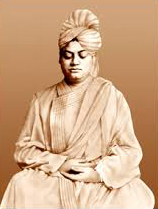
Swami Vivekananda (12 January 1863 – 4 July 1902) was an Indian saint, social reformer, and a great teacher of mankind. He was the foremost disciple of Bhagavan Sri Ramakrishna Paramahamsa Dev who is considered as the prophet of modern age. Swami Vivekananda was a towering spiritual personality, great thinker, orator and the prophet of universal harmony and progress.