
Swami Vivekananda Quotes on Concentration

Chapter 6: Concentration
A profound collection of 30 sayings and teachings of Swami Vivekananda on Concentration, compiled from the Complete Works of Swami Vivekananda (C.W.).
“Concentration is restraining the mind into smaller and smaller limits.”
“Meditation is the focusing of the mind on some object. If the mind acquires concentration on one object, it can be so concentrated on any object whatsoever.”
“Concentrating the powers of the mind is the only way to knowledge. In external science, concentration of mind is—putting it on something external; and in internal science, it is — drawing towards one’s Self. We call this concentration of mind Yoga.”
“Concentration is the essence of all knowledge; nothing can be done without it.”
“There is no limit to the power of the human mind. The more concentrated it is, the more power is brought to bear on one point; that is the secret.”
“How has all the knowledge in the world been gained but by the concentration of the powers of the mind? The world is ready to give up its secrets if we only know how to knock, how to give it the necessary blow. The strength and force of the blow come through concentration.”
“The difference in this world between mind and mind is simply the fact of concentration. One, more concentrated than the other, gets more knowledge.”
“Herein is the difference between man and the animals—man has the greater power of concentration. The difference in their power of concentration also constitutes the difference between man and man. Compare the lowest with the highest man. The difference is in the degree of concentration. This is the only difference.”
“The main difference between men and the animals is the difference in their power of concentration. All success in any line of work is the result of this. Everybody knows something about concentration. We see its results every day. High achievements in art, music, etc., are the results of concentration.”
“The more I can concentrate my thoughts on the matter on which I am talking to you, the more light I can throw upon you. You are listening to me, and the more you concentrate your thoughts, the more clearly you will grasp what I have to say.”
“The more this power of concentration, the more knowledge is acquired, because this is the one and only method of acquiring knowledge.”
“We have but one method of acquiring knowledge. From the lowest man to the highest Yogi, all have to use the same method; and that method is what is called concentration. The chemist who works in his laboratory concentrates all the powers of his mind, brings them into one focus, and throws them on the elements; and the elements stand analysed, and thus his knowledge comes. The astronomer has also concentrated the powers of his mind and brought them into one focus; and he throws them on to objects through his telescope; and stars and systems roll forward and give up their secrets to him. So it is in every case—with the professor in his chair, the student with his book—with every man who is working to know.”
“In the lives of all great men, past and present, we find this tremendous power of concentration. Those are men of genius, you say. The science of Yoga tells us that we are all geniuses if we try hard to be. Some will come into this life better fitted and will do it quicker perhaps. We can all do the same. The same power is in everyone.”
“Concentration will bring perfect repose to mind and body every time it is practised.”
“Everybody’s mind becomes concentrated at times. We all concentrate upon those things we love, and we love those things upon which we concentrate our minds.”
“The practice of meditation even with some trifling external object leads to mental concentration. But it is true that the mind very easily attains calmness when one practices meditation with anything on which one’s mind is most apt to settle down. This is the reason why we have in this country so much worship of the images of gods and goddesses. And what wonderful art developed from such worship!”
“Music has such tremendous power over the human mind; it brings it to concentration in a moment.”
“Concentration, of course, comes from various sources. Through the senses you can get concentration. Some get it when they hear beautiful music, others when they see beautiful scenery.… Some get concentrated by lying upon beds of spikes, sharp iron spikes, others by sitting upon sharp pebbles. These are extraordinary cases using most unscientific procedure. Scientific procedure is gradually training the mind.”
“The purer the mind, the easier it is to control it. The mind takes every thought that rises and works it out. The grosser the mind, the more difficult it is to control it.”
“If the painter, losing the consciousness of his ego, becomes completely immersed in his painting, he will be able to produce masterpieces. The good cook concentrates his whole self on the food-material he handles; he loses all other consciousness for the time being. But they are only able to do perfectly a single work in this way, to which they are habituated. The Gita teaches that all works should be done thus.”
“Gita teaches Karma-Yoga. We should work through Yoga (concentration). In such concentration in action (Karma-Yoga), there is no consciousness of the lower ego present. The consciousness that I am doing this and that is never present when one works through Yoga.”
“All the great prophets, saints, and seers of the world—what did they do? In one span of life they lived the whole life of humanity, traversed the whole length of time that it takes ordinary humanity to come to perfection. In one life they perfect themselves; they have no thought for anything else, never live a moment for any other idea, and thus the way is shortened for them. This is what is meant by concentration, intensifying the power of assimilation, thus shortening the time. Raja-Yoga is the science which teaches us how to gain the power of concentration. Through concentration of mind everything can be accomplished—even mountains can be crushed to atoms.”
“The old idea was: “Develop one idea at the expense of all the rest.” The modern way is “harmonious development.” A third way is to “develop the mind and control it,” then put it where you will; the result will come quickly. This is developing yourself in the truest way. Learn concentration and use it in any direction.”
“Concentration of the powers of the mind is our only instrument to help us see God. If you know one soul (your own), you know all souls, past, present, and to come. The will concentrates the mind, certain things excite and control this will, such as reason, love, devotion, breathing. The concentrated mind is a lamp that shows us every corner of the soul.”
“By great struggle we get a certain power of concentration, the power of attachment of the mind to certain things. But then there is not the power of detachment. I would give half my life to take my mind off that object! I cannot. It is the power of concentration and attachment as well as the power of detachment that we must develop. If the man is equally powerful in both—that man has attained manhood.”
“On the ethical side there is danger in the development of the power of concentration—the danger of concentrating the mind upon an object and then being unable to detach it at will. This state causes great suffering. Almost all our suffering is caused by our not having the power of detachment. So along with the development of concentration we must develop the power of detachment.”
“How are we to know that the mind has become concentrated? Because the idea of time will vanish. The more time passes unnoticed the more concentrated we are. In common life we see that when we are interested in a book we do not note the time at all, and when we leave the book we are often surprised to find how many hours have passed. All time will have the tendency to come and stand in the one present. So the definition is given, when the past and present come and stand in one, the mind is said to be concentrated.”
“When one works with concentration, losing all consciousness of oneself the work that is done will be infinitely better, and this every one may have experienced in his own life.”
“In training the mind the first step is to begin with breathing. Regular breathing puts the body in a harmonious condition; and it is then easier to reach the mind. In practising breathing, the first thing to consider is Asana or posture. Any posture in which a person can sit easily is his proper position. The spine should be kept free, and the weight of the body should be supported by the ribs. Do not try by contrivances to control the mind; simple breathing is all that is necessary in that line. All austerities to gain concentration of the mind are a mistake. Do not practise them.”
“The thing is you must make the mind steadfast on something. If it is steadfast on one object, it attains to concentration, that is, its other modifications die out and there is a uniform flow in one direction.”
Comments
Comments are closed for this post.
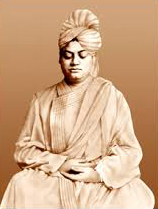
Swami Vivekananda (12 January 1863 – 4 July 1902) was an Indian saint, social reformer, and a great teacher of mankind. He was the foremost disciple of Bhagavan Sri Ramakrishna Paramahamsa Dev who is considered as the prophet of modern age. Swami Vivekananda was a towering spiritual personality, great thinker, orator and the prophet of universal harmony and progress.