
Swami Vivekananda Quotes on Bhakti Yoga

Chapter 2: Bhakti Yoga
A profound collection of 30 sayings and teachings of Swami Vivekananda on Bhakti Yoga, compiled from the Complete Works of Swami Vivekananda (C.W.).
“Bhakti-Yoga is a real, genuine search after the Lord, a search beginning, continuing, and ending in love.”
“One single moment of the madness of extreme love to God brings us eternal freedom.”
“Bhakti is a series or succession of mental efforts at religious realisation beginning with ordinary worship and ending in a supreme intensity of love for Ishvara.”
“All is Brahman, the One without a second; only the Brahman, as unity or absolute, is too much of an abstraction to be loved and worshipped; so the Bhakta chooses the relative aspect of Brahman, that is, Ishvara, the Supreme Ruler.”
“Ishvara is the highest manifestation of the Absolute Reality, or in other words, the highest possible reading of the Absolute by the human mind. Creation is eternal, and so also is Ishvara.”
“Worshipping Ishvara and Him alone is Bhakti; the worship of anything else—Deva, or Pitri, or any other being—cannot be Bhakti. The various kinds of worship of the various Devas are all to be included in ritualistic Karma, which gives to the worshipper only a particular result in the form of some celestial enjoyment, but can neither give rise to Bhakti nor lead to Mukti.”
“There must be a continuous struggle, a constant fight, an unremitting grappling with our lower nature, till the higher want is actually felt and the victory is achieved.”
“Those to whom the eternal interests of the soul are of much higher value than the fleeting interests of this mundane life, to whom the gratification of the senses is but like the thoughtless play of the baby, to them God and the love of God form the highest and the only utility of human existence.”
“No impure soul can be really religious. Purity in thought, speech, and act is absolutely necessary for any one to be religious.”
“What religion can an impure man teach? The sine qua non of acquiring spiritual truth for one’s self or for imparting it to others is the purity of heart and soul. A vision of God or a glimpse of the beyond never comes until the soul is pure. Hence with the teacher of religion we must see first what he is, and then what he says.”
“The only medium through which spiritual force can be transmitted is love. Any selfish motive, such as the desire for gain or for name, will immediately destroy this conveying medium.”
“God is love, and only he who has known God as love can be a teacher of godliness and God to man.”
“Without faith, humility, submission, and veneration in our hearts towards our religious teacher, there cannot be any growth of religion in us.”
“Wherever His name is spoken, that very place is holy. How much more so is the man who speaks His name, and with what veneration ought we to approach that man out of whom comes to us spiritual truth! Such great teachers of spiritual truth are indeed very few in number in this world, but the world is never altogether without them. They are always the fairest flowers of human life.”
“We cannot help seeing God as man, and, therefore, we are bound to worship Him as man. There is no other way.”
“God understands human failings and becomes man to do good to humanity.”
“When His light, His presence, His spirit, shines through the human face, then and then alone, can man understand Him. Thus, man has been worshipping God through men all the time, and must do so as long as he is a man. He may cry against it, struggle against it, but as soon as he attempts to realise God, he will find the constitutional necessity of thinking of God as a man.”
““When a huge tidal wave comes,” says Bhagavan Sri Ramakrishna, “all the little brooks and ditches become full to the brim without any effort or consciousness on their own part; so when an Incarnation comes, a tidal wave of spirituality breaks upon the world, and people feel spirituality almost full in the air.””
“It is very good to be born in a church, but it is very bad to die in a church. It is very good to be born within the limits of certain forms that help the little plant of spirituality, but if a man dies within the bounds of these forms, it shows that he has not grown, that there has been no development of the soul.”
“Temples or churches, books or forms, are simply the kindergarten of religion, to make the spiritual child strong enough to take higher steps; and these first steps are necessary if he wants religion. With the thirst, the longing for God, comes real devotion, real Bhakti.”
“One who aspires to be a Bhakta must know that “so many opinions are so many ways.” He must know that all the various sects of the various religions are the various manifestations of the glory of the same Lord.”
“The Bhakta must take care not to hate, nor even to criticise those radiant sons of light who are the founders of various sects; he must not even hear them spoken ill of.”
“The growing plant must be hedged round to protect it until it has grown into a tree. The tender plant of spirituality will die if exposed too early to the action of a constant change of ideas and ideals.”
““The mind must always think of the Lord.” It is very hard at first to compel the mind to think of the Lord always, but with every new effort the power to do so grows stronger in us. “By practice, O son of Kunti, and by non-attachment is it attained,” says Shri Krishna in the Gita.”
“It is the strong body alone that can bear the shock of reaction resulting from the attempt to control the organs. He who wants to become a Bhakta must be strong, must be healthy.”
“The mentally weak also cannot succeed in attaining the Atman. The person who aspires to be a Bhakta must be cheerful.”
“It is the cheerful mind that is persevering. It is the strong mind that hews its way through a thousand difficulties. And this, the hardest task of all, the cutting of our way out of the net of Maya, is the work reserved only for giant wills.”
“Bhakti-Yoga does not say, “Give up”; it only says, “Love; love the Highest!”—and everything low naturally falls off from him, the object of whose love is the Highest.”
“What an immense pleasure men take in the objects of the senses. They go anywhere, run through any danger, to get the thing which they love, the thing which their senses like. What is wanted of the Bhakta is this very kind of intense love which has, however, to be directed to God.”
“With the love of God will come, as a sure effect, the love of every one in the universe. The nearer we approach God, the more do we begin to see that all things are in Him.”
Comments
Comments are closed for this post.
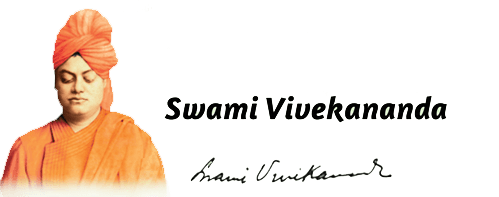
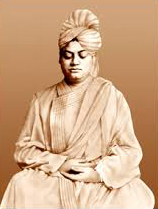
Swami Vivekananda (12 January 1863 – 4 July 1902) was an Indian saint, social reformer, and a great teacher of mankind. He was the foremost disciple of Bhagavan Sri Ramakrishna Paramahamsa Dev who is considered as the prophet of modern age. Swami Vivekananda was a towering spiritual personality, great thinker, orator and the prophet of universal harmony and progress.